
 You’ve invested considerably in your modern home, haven’t you? The last thing you want is water damage creeping in from your crawl space. It’s a complex problem, requiring more than a one-size-fits-all solution. Between exterior drainage systems, interior vapor barriers, sump pumps, sealants, and more, it’s essential to understand which methods provide the finest protection. But with so many options, how can you determine which are ideal for your home? Let’s explore this together, and you’ll soon be equipped to make an informed decision that guarantees your home’s longevity.
Understanding Crawl Space Waterproofing
Nearly every homeowner will, at some point, need to understand crawl space waterproofing. It’s not a glamorous aspect of home maintenance, but it’s vital for the longevity of your property.
You see, crawl spaces, those low-height areas found beneath some homes, are prone to moisture accumulation. This can lead to several problems, such as mold growth, structural damage, and poor indoor air quality.
To prevent these issues, crawl space waterproofing becomes essential. Broadly speaking, there are two methods: exterior and interior waterproofing.
Exterior waterproofing involves the application of a waterproof barrier to the outside walls of the crawl space. This method is typically more labor-intensive and costly, but it offers superior protection against both surface water and groundwater.
Interior waterproofing, on the other hand, tackles moisture once it has entered the crawl space. This method primarily involves the installation of a water drainage system and a sump pump to remove water.
It’s less expensive than exterior waterproofing, but it doesn’t prevent moisture from entering the crawl space in the first place.
Understanding these methods, their pros, and cons, is the first step to making an informed decision about crawl space waterproofing.
Vapor Barrier Installation Method
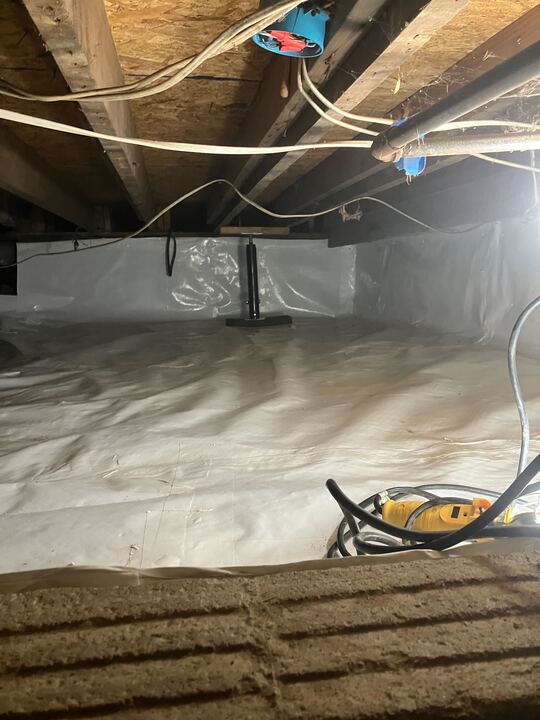
One popular and effective method for crawl space waterproofing is the installation of a vapor barrier. This barrier, typically made of thick, durable plastic, is installed on the floor and walls of your crawl space, effectively sealing it off from the moisture in the ground and air. Here’s where precision comes into play: the barrier must be meticulously sealed at all seams and junctions to prevent any moisture intrusion.
Let’s break down the process:
| Step | Task | Importance |
|---|---|---|
| 1 | Preparation | Clean the area, remove sharp objects that could puncture the barrier. |
| 2 | Installation | Lay the barrier, ensuring it covers the entire floor and walls, overlap and seal seams. |
| 3 | Inspection | Inspect for any potential leaks and seal them. |
Installing a vapor barrier isn’t just about laying plastic, it’s about creating a moisture-resistant seal. You’re not just preventing visible water, but also water vapor, which could lead to mold, mildew, and structural damage over time. It’s a detailed task requiring technical know-how. If done correctly, you’ll greatly increase the lifespan of your home by preventing moisture-related damages. Remember, an efficient vapor barrier is a key component of a well-protected crawl space.
Exterior Drainage Systems
While a vapor barrier is a powerful tool in your crawl space waterproofing arsenal, it’s not the only method to reflect upon. You should also think about implementing exterior drainage systems to your home, as they can provide an additional layer of protection against water intrusion.
Exterior drainage systems, often comprised of French drains or footing drains, are designed to divert water away from your home’s foundation. The system functions by capturing water that accumulates around the foundation and diverting it away, preventing it from seeping into your crawl space.
French drains, for instance, work by utilizing a slope in their design to naturally guide water away from the home, while footing drains are installed around the perimeter of your home at the footing level to catch and reroute water.
It’s essential to make sure these systems are installed correctly for peak performance. Poor installation could result in inadequate drainage, leading to greater water accumulation and potential damage.
As a result, you might want to think about hiring a professional to execute this task.
Sump Pump Implementation
In addition to an exterior drainage system, implementing a sump pump in your crawl space can offer substantial protection against water intrusion. Sump pumps work by collecting water that enters the crawl space and then pumping it away from the house. It’s an effective measure to keep your crawl space dry and prevent damage that can be caused by water infiltration.
Make certain that the sump pump is correctly installed. It should be placed in the lowest part of the crawl space in a specially constructed sump pit. The correct installation is essential for the efficient operation of the pump. Here’s a table summarizing the necessary steps for proper installation:
| Step | Action | Rationale |
|---|---|---|
| 1 | Dig the sump pit | To collect the water |
| 2 | Install the sump pump | To pump water out |
| 3 | Connect to drainage | To direct the water away |
Regular maintenance is also important. It’s necessary to periodically check the system to verify it’s working correctly. This can be done by pouring water into the pit and observing if the pump activates and expels the water efficiently. If not, it might require repair or replacement. With proper installation and maintenance, a sump pump can be a key component in your crawl space waterproofing strategy.
Sealants and Concrete Coatings
Beyond the installation of a sump pump, another valuable approach to crawl space waterproofing is the application of sealants and concrete coatings. These products provide a barrier that not only resists water penetration but also enhances the durability of your crawl space.
Sealants are typically liquid-based solutions that you can apply to the concrete walls and floors of your crawl space. They seep into the pores of the concrete, filling them to prevent water intrusion. There are several types you can choose from, including acrylics, silicones, and urethanes. Each comes with its own strengths and weaknesses, but all provide a good level of protection against moisture.
Concrete coatings, on the other hand, are more robust. They’re thicker and more resilient, and they’re formulated to withstand substantial hydrostatic pressure. These coatings are often epoxy or polyurea-based, creating a waterproof layer that bonds firmly with your crawl space’s concrete surfaces.
It’s essential to analyze your crawl space’s specific needs and the local climate when deciding between sealants and coatings. Each product has its own installation methods, curing times, and maintenance requirements, so it’s vital to understand these aspects before making a choice.
Conclusion
So, you’ve explored the best crawl space waterproofing methods for modern homes. From installing a vapor barrier to implementing exterior drainage systems and sump pumps, you’ve seen how these techniques can shield your home from moisture damage. Don’t forget the importance of sealants and concrete coatings, too. By integrating these strategies, you’re ensuring a dry, mold-free environment, improving air quality, and boosting your home’s structural longevity. Now, it’s up to you to implement these techniques for ideal protection.

Ohio State Waterproofing has provided quality service with over 90,000 successful waterproofing and foundation repair installations and satisfied customers since our inception in 1978.
Ohio State Waterproofing’s philosophy for success is to provide honest, courteous and guaranteed service to every customer. Our reputation reflects this. Our well-trained waterproofing technicians are dedicated to complete customer satisfaction. This is achieved through fast, efficient processes as well as teamwork throughout this organization. You will always find a friendly representative willing to meet your needs at Ohio State Waterproofing.
We are a full service company that handles problems ranging from patching cracks to rebuilding basements. In addition, we hold three patents related to waterproofing that make us unique in the industry. These patents and our experience allow us to be able to do what every other waterproofer can do, but no one else can do what we do.
We are actively involved in the industry and community, including the National Association of Waterproofing Contractors, BHA, NARI, NAHB, NHIA, the BIA, the FHA and a number of consumer advocacy groups, as well as playing leading roles in a number of charitable functions.
But, most importantly, our highest degree of praise comes from the thousands of referrals we get from satisfied customers. Together they’ve made us a leader in the basement waterproofing and foundation repair industry.
